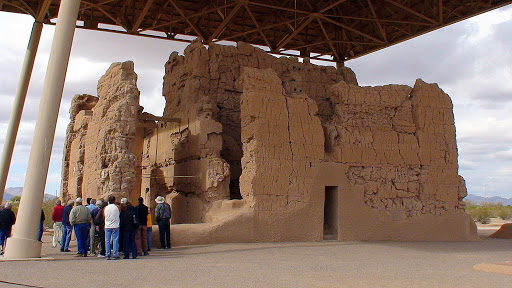
Casa Grande was built at the rise of the first known civilization in Arizona. The people who built it are called Hohokam, which is a name used to identify the people who first lived in the Sonoran Desert. This structure, the big house, was completed by 1350 CE (AD) and was found to be abandoned by a group of missionaries by 1694 CE (AD). The word Ho-ho-kahm was used by the Pima Indians about its inhabitants, their ancestors, meaning “all-gone” or “all used up”. (they probably meant the resources here, which is why many ancient Indian tribes abandoned a place and moved on to build anew)
This was called Casa Grande by those missionaries for a reason. It was constructed from 3,000 of Caliche, a concrete-like mix of sand, clay and calcium carbonate (limestone). The mud was formed in courses to build a low wall that was four feet thick at the base.

Then, small trees were felled and floated down the nearby Gila River and stood up, anchored in the walls to form vertical supports. Saguaro branches, called ribs, were then laid perpendicularly across the ribs, and covered perpendicularly again with reeds. All these layers were covered by a final coating of Caliche mud.

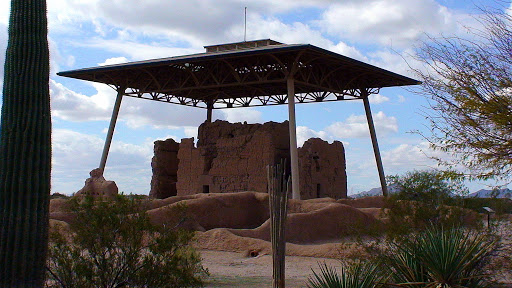
In 1932 a ramada called the Olmsted Shelter was built to shelter the ruins from weathering.

The building was built so that it’s four sides face the four cardinal directions, holes were made in the walls to line up with the sun and moon at certain times of the year that would indicate to them the time to plant, harvest and to give thanks and celebrate.

The Hohokam people dug an intricate series of canals with interlocking gates that brought water from the Gila River into the village for irrigation and for this hunter/gatherer society.

This is how the settlement was set up. Compounds were a collection of spaces surrounded by walls that served as living areas and religious and other daily activities. Notice that there was an oval shaped ball court near the center of the community.

This is what it looks like now. It was probably used for ball games similar to the ones the Aztecs played. (ball courts have been found as far north as northern Arizona)

This is what this ball court may have looked like in the day of the Hohokam.

These mounds are near the ball court and are in the location of the city center. The platform mound may have served a religious function and/or been a location of social hierarchy and ancestral status. Meaning, the reigning family, and religious leaders, held rituals on top of the mound, and when they were gone (for one reason or another), they were laid on top and the earth was mounded up over them making another level higher, where the next leaders would be.

It was a very intriguing place to be…

… and it was another dog-friendly place…

…where Angie was glad she could come with us…

… and politely waited her turn in line to see.